

One of the stranger things about growing older is realizing that almost everyone believes they are humble, but I think most of us are walking around with a false definition of what humility actually means.
I have met very few people who would openly describe themselves as arrogant. Most of us assume we see ourselves fairly clearly, assume we understand our strengths and weaknesses reasonably well, and tend to believe that if pride exists, it is usually somebody else’s problem. We don’t walk around thinking we are better than everybody else. We might even use self-deprecating language and jokes. Yet the older I get, the more convinced I become that one of the great struggles of adulthood, whether in business, marriage, politics, fatherhood, or faith, is that many of us are fighting reality without even realizing it.
If you prefer to listen, follow the link below to youtube. If not, skip down and keep reading.
The businessman who believes he is a visionary when he is actually disorganized. The employee convinced he is perpetually overlooked when, in truth, he has not yet earned greater responsibility. The politician who sees himself as persuasive while exhausting everyone around him. The father who believes he is deeply present because he pays the bills, while his children increasingly feel disconnected from him. The spouse who insists they are easy to live with while everyone else adjusts their behavior to keep the peace.
What if humility is not thinking less of yourself?
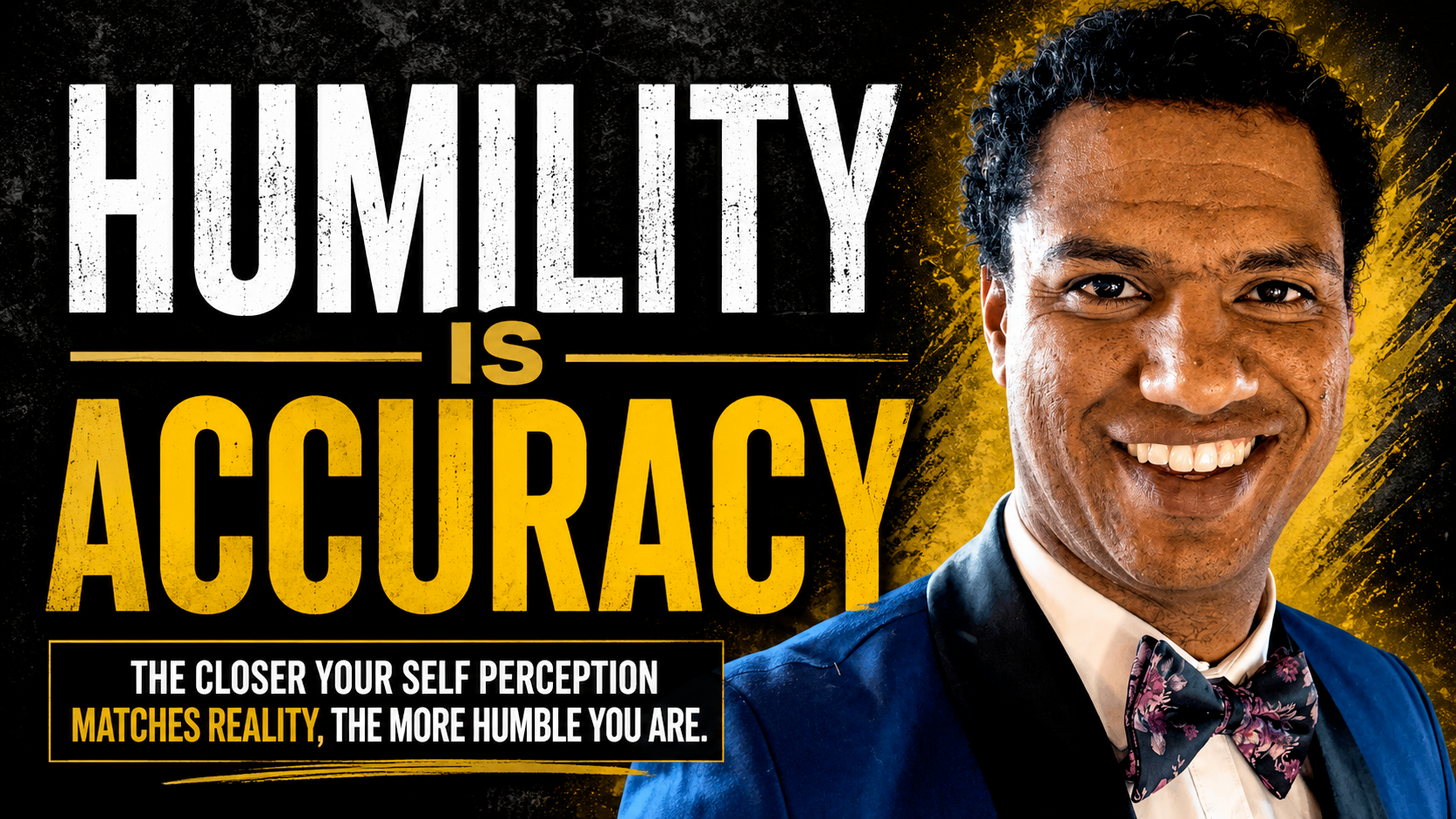
What if humility is simply accuracy?
The older I get, the more I suspect humility has less to do with lowering yourself and more to do with seeing yourself honestly, your gifts honestly, your flaws honestly, your place in reality honestly, and then adjusting your behavior accordingly.
To put it more plainly, the closer your self perception matches reality, the more humble you are.
This matters far more than most people realize because inaccurate people tend to leave so much damage behind them. Think about the worse villain in your favorite childhood story. The good ones aren’t “evil” for evil’s sake. They are victims in their own minds. They’ve been slighted, even if it’s by accident, or overlooked for some promotion and therefore they take vengeance out of the world. They are completely cut off from the reality of the fact that they just weren’t that good, or that nobody even noticed the slight, it wasn’t malicious.
Some people dramatically overestimate themselves. They think they are wiser than they are, more disciplined than they are, stronger leaders than they are, and because of that they refuse correction, dismiss criticism, and continue charging into walls while blaming circumstances, difficult people, bad timing, or almost anything except their own blind spots.
But underestimating yourself can be just as destructive.
I have known remarkably gifted people who convinced themselves they had little to offer, avoided responsibility, turned down opportunities, or buried their strengths because insecurity somehow felt holier than confidence. But false humility is still inaccuracy, and reality does not reward distortion simply because it sounds modest. This is often the hero in your favorite story. Overlooking what must be done and they they must be the one to do it until some catalyst pushes responsibility onto them and they step into their destiny where they learn an honest perception of themselves and that’s how they defeat the ungrounded villain who is committed to an alternate reality. But without that catalyst they both do damage, on passively and one actively.
The insecure person and the arrogant person often suffer from the exact same disease.
Both are misreading reality.
One inflates himself.
The other shrinks himself.
Neither sees clearly.
This becomes intensely practical once you move beyond theory.
Take marriage.
If your spouse genuinely has better instincts in a particular area, humility may mean acknowledging that honestly and adapting without resentment. If one spouse handles finances better, reads people more accurately, communicates more effectively, or simply possesses stronger judgment in a particular arena, wisdom is not pretending equality where it does not exist. Wisdom is recognizing strengths honestly and leveraging them for the good of the family.
The reverse is equally true.
Humility does not mean pretending weakness where there is strength, nor does it mean diminishing competence to avoid making others uncomfortable. If you are stronger in a certain area, pretending otherwise is not virtue. It is still a refusal to tell the truth. God can insist upon glory and honor and praise for Himself as awesome in ways that we would call arrogant if it were insisted upon by a president, a king or a Caesar precisely because He actually is that awesome. His insistence on praise in that manner is in line with reality.
The same principle governs business.
The leader who cannot honestly evaluate himself eventually builds a weaker company because he hires poorly, delegates poorly, and compensates for insecurity by controlling too much. Meanwhile, leaders who understand both their strengths and limitations tend to build healthier organizations, surround themselves with people who compensate for their weaknesses, and become far harder to destabilize because they are not exhausting themselves defending illusions.
And that’s why humility matters. It’s not just some virtue you signal to others so that they admire you for how noble you are. That’s far too abstract for humility to be the number one most important trait you can have. It’s because the amount of humility to you have is exactly about how much aligned with reality you are. And the more aligned with reality you are means the clearer you see the world and the more accurate your decisions about how to interact with it. If you’re humble you’ll be less in love with your own product and more in love with how it can solve your customer’s problem and they will feel that. If you’re humble you can ask your husband for how high to set the oven to make his mother’s signature dish because you care more about the enjoyment the family will get from it cooked well than proving that you’re just as good a cook as she was. Humility lets you focus on the result out in the real world and not worry about how highly you or others should esteem yourself. Humility asks, “who cares?” when it comes to your self esteem, and instead it reminds you that you should esteem yourself exactly as highly as the true fruit you bear. Envy is not a bad virtue that humility is so holy that it must expel. Envy is a waste of time as far as humility is concerned. But then again, so is making sure you get the credit.
Reality is undefeated.
Sooner or later, businesses expose incompetence, marriage exposes selfishness, parenting exposes impatience, politics exposes ego, and life itself has a way of humiliating people who insist on arguing with what is true.
Perhaps this is why humility matters more than intelligence, talent, charisma, or skill.
After all, what good is talent if pride blinds you to your weaknesses? What good is intelligence if you cannot accurately assess yourself? What good is charisma if insecurity keeps you from receiving correction?
Humility may actually be the skill beneath all other skills because it determines whether we can interact honestly with reality.
And reality, unlike our egos, does not negotiate.
Five Practical Ways To Grow In Humility
Ask trusted people where your blind spots are. If three wise people consistently tell you the same thing, pay attention.
Separate identity from correction. Being wrong about something does not make you worthless, it makes you human.
Stop confusing insecurity with humility. Diminishing yourself is not virtue if it ignores reality.
Pay attention to where life keeps pushing back on you. Repeated friction in business, leadership, or relationships often reveals inaccurate self perception.
Practice admiring competence without envy. When somebody genuinely surpasses you in an area, learn from them instead of competing with reality.
When you think about your own life, where have you most misread yourself, either overestimating or underestimating who you really are? Leave it in the comments, I suspect many of us have learned some painful lessons in ways that might help somebody else.
Not subscribed but want to join the conversation? The free subscribe option lets you jump into the comments, no paid membership needed. I’d genuinely love to hear your perspective.
Wow! I loved the way you presented humility in this piece. I needed this. It reminded me that the truest expression of humility is found in how our actions - and even our inactions - impact the people around us. Thanks brother.